
Monday, August 15, 2011


Friday, August 12, 2011
We Are Seven
by
William Wordsworth (1770 - 1850)
--------------A simple Child,
That lightly draws its breath,
And feels its life in every limb,
What should it know of death?
I met a little cottage Girl:
She was eight years old, she said;
Her hair was thick with many a curl
That clustered round her head.
She had a rustic, woodland air,
And she was wildly clad:
Her eyes were fair, and very fair;
-- Her beauty made me glad.
And wondering looked at me.
She answered,
Then did the little Maid reply,
The little Maid replied,
"Twelve steps or more from my mother's door,
And they are side by side.
"My stockings there I often knit,
My kerchief there I hem;
And there upon the ground I sit,
And sing a song to them.
"And often after sunset, Sir,
When it is light and fair,
I take my little porringer,
And eat my supper there.
"The first that died was sister Jane;
In bed she moaning lay,
Till God released her of her pain;
And then she went away.
"So in the churchyard she was laid;
And, when the grass was dry,
Together round her grave we played,
My brother John and I.
Quick was the little Maid's reply,
'Twas throwing words away; for still
The little Maid would have her will,
And said,

William Wordsworth (1770 - 1850)
--------------A simple Child,
That lightly draws its breath,
And feels its life in every limb,
What should it know of death?
I met a little cottage Girl:
She was eight years old, she said;
Her hair was thick with many a curl
That clustered round her head.
She had a rustic, woodland air,
And she was wildly clad:
Her eyes were fair, and very fair;
-- Her beauty made me glad.
Sisters and brothers, little Maid,
How many may you be?
How many? Seven in all,she said,
And wondering looked at me.
And where are they? I pray you tell.
She answered,
Seven are we;
And two of us at Conway dwell,
And two are gone to sea.
Two of us in the church-yard lie,
My sister and my brother;
And, in the church-yard cottage, I
Dwell near them with my mother.
You say that two at Conway dwell,
And two are gone to sea,
Yet ye are seven! -- I pray you tell,
Sweet Maid, how this may be.
Then did the little Maid reply,
Seven boys and girls are we;
Two of us in the church-yard lie,
Beneath the church-yard tree.
You run about, my little Maid,
Your limbs they are alive;
If two are in the church-yard laid,
Then ye are only five.
Their graves are green, they may be seen,
The little Maid replied,
"Twelve steps or more from my mother's door,
And they are side by side.
"My stockings there I often knit,
My kerchief there I hem;
And there upon the ground I sit,
And sing a song to them.
"And often after sunset, Sir,
When it is light and fair,
I take my little porringer,
And eat my supper there.
"The first that died was sister Jane;
In bed she moaning lay,
Till God released her of her pain;
And then she went away.
"So in the churchyard she was laid;
And, when the grass was dry,
Together round her grave we played,
My brother John and I.
And when the ground was white with snow,
And I could run and slide,
My brother John was forced to go,
And he lies by her side.
How many are you then,said I,
If they two are in heaven?
Quick was the little Maid's reply,
O Master! we are seven.
But they are dead; those two are dead!
Their spirits are in heaven!
'Twas throwing words away; for still
The little Maid would have her will,
And said,
Nay, we are seven!"

The Conwy Churchyard in the Lake District, England made famous by this poem
Source of Image: http://images.suite101.com/3193075_com_weareseven.jpg
Shoot all the bluejays you want, but remember it's a sin to kill a mockingbird
 Undoubtedly one of the classics of world literature! If you haven't read this yet, you had better not miss out any longer. Read it the first chance you get. Here are a few glimpses from this gem of a book:
The story is about the brother-sister duo of Jem and Scout Finch aged 10 and 6 respectively, and their father, Atticus Finch, who is a lawyer (and one of the wisest and most brilliant characters ever penned down in history). Various incidents take place in the story the common point between all being the importance of not making judgements about people without knowing them for yourself. All of us make impressions about people when we first see them, which is inevitable. The important point to remember is not to let those impressions guide our behaviour towards people, because our impressions may have been completely wrong. Keep an open mind. As Atticus says: "... most people are [nice] Scout when you finally see them."
Have fun reading these memorable quotes from the book (courtesy the wit of Harper Lee. What do you mean Haprer Lee who? The author of course :D )
"Before I can live with other folks I've got to live with myself. The one thing that doesn't abide by majority rule is a person's conscience. "
- Atticus Finch
"I wanted you to see what real courage is, instead of getting the idea that courage is a man with a gun in his hand. It's when you know you're licked before you begin but you begin anyway and you see it through no matter what. You rarely win, but sometimes you do. "
- Atticus Finch
"So it took an eight-year-old child to bring 'em to their senses.... That proves something - that a gang of wild animals can be stopped, simply because they're still human. Hmp, maybe we need a police force of children."
- Atticus Finch
"The one place where a man ought to get a square deal is in a courtroom, be he any color of the rainbow, but people have a way of carrying their resentments right into a jury box. As you grow older, you'll see white men cheat black men every day of your life, but let me tell you something and don't you forget it - whenever a white man does that to a black man, no matter who he is, how rich he is, or how fine a family he comes from, that white man is trash. "
- Atticus Finch
"I think there's just one kind of folks. Folks."
- Scout Finch
"If there's just one kind of folks, why can't they get along with each other? If they're all alike, why do they go out of their way to despise each other?"
- Jem Finch
"When a child asks you something, answer him, for goodness' sake. But don't make a production of it. Children are children, but they can spot an evasion quicker than adults, and evasion simply muddles 'em."
- Atticus Finch
"You never really understand a person until you consider things from his point of view--until you climb inside of his skin and walk around in it."
- Atticus Finch
- Atticus Finch
"The witnesses for the state have presented themselves to you gentlemen, to this court, in the cynical confidence that their testimony would not be doubted, confident that you gentlemen would go along with them on the assumption - the evil assumption - that all Negroes lie, that all Negroes are basically immoral beings, that all Negro men are not to be trusted around our women, an assumption one associates with minds of their caliber. Which, gentlemen, we know is in itself a lie as black as Tom Robinson's skin, a lie I do not have to point out to you. You know the truth, the truth is this: some Negroes lie, some Negroes are immoral, some Negro men cannot be trusted around women, black or white. But this is a truth that applies to the human race and to no particular race of men."
- Atticus Finch (to the jury)
- Atticus Finch (to the jury)
"There's a lot of ugly things in this world, son. I wish I could keep 'em all away from you. That's never possible."
- Atticus Finch
- Atticus Finch
“Remember it’s a sin to kill a mockingbird.” That was the only time I ever heard Atticus say it was a sin to do something, and I asked Miss Maudie about it.
“Your father’s right,” she said. “Mockingbirds don’t do one thing but make music for us to enjoy . . . but sing their hearts out for us. That’s why it’s a sin to kill a mockingbird.”
“Your father’s right,” she said. “Mockingbirds don’t do one thing but make music for us to enjoy . . . but sing their hearts out for us. That’s why it’s a sin to kill a mockingbird.”
- Scout Finch
“When they finally saw him, why he hadn’t doneany of those things . . . Atticus, he was real nice. . . .” "Most people are, Scout, when you finally see them.”
- Scount & Atticus Finch
Monday, August 8, 2011
Beth Gellert
byWilliam Robert Spencer (1769-1834)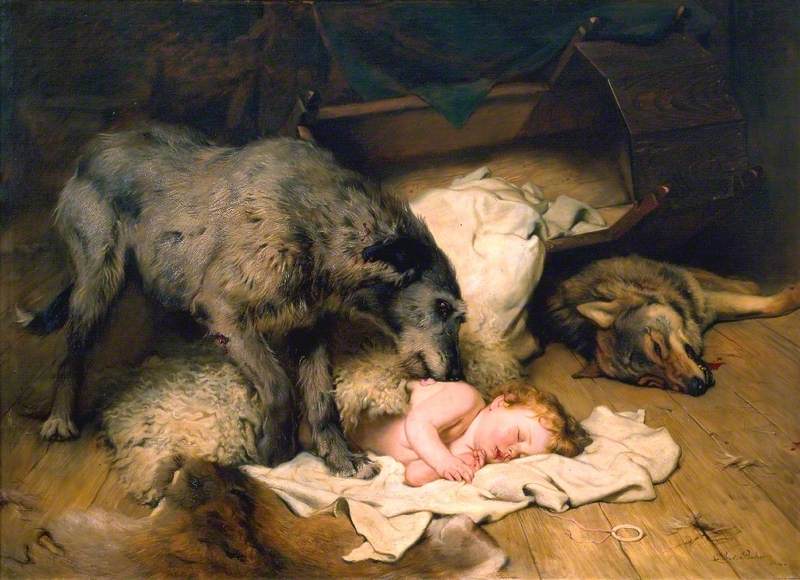
The spearmen heard the bugle sound,
And cheerly smiled the morn;
And many a brach, and many a hound,
Obeyed Llewelyn's horn.

And still he blew a louder blast,
And gave a lustier cheer:
'Come, Gelert come, wer't never last
Llewelyn's horn to hear.

'Oh where does faithful Gelert roam,
The flower of all his race;
So true, so brave, a lamb at home,
A lion in the chase?'

'Twas only at Llewelyn's board
The faithful Gelert fed;
He watched, he served, he cheered his lord,
And sentinelled his bed.

In sooth he was a peerless hound,
The gift of royal John;
But now no Gelert could be found,
And all the chase rode on.

And now, as o'er the rocks and dells
The gallant chidings rise,
All Snowdon's craggy chaos yells
The many-mingled cries.

That day Llewelyn little loved
The chase of hart and hare;
And scant and small the booty proved,
For Gelert was not there.

Unpleased Llewelyn homeward hied,
When near the portal seat
His truant Gelert he espied,
Bounding his lord to greet.

But when he gained his castle door
Aghast the chieftain stood;
The hound all o'er was smeared with gore,
His lips, his fangs, ran blood.

Llewelyn gazed with fierce surprise;
Unused such looks to meet,
His favourite checked his joyful guise,
And crouched, and licked his feet.

Onward in haste Llewelyn passed,
And on went Gelert too;
And still, where'er his eyes he cast,
Fresh blood-gouts shocked his view.

O'erturned his infants bed he found,
With blood-stained covert rent;
And all around the walls and ground
With recent blood besprent.

He called his child--no voice replied--
He searched with terror wild;
Blood, blood he found on every side,
But nowhere found his child.

'Hell hound! my child's by thee devoured,'
The frantic father cried;
And to the hilt his vengeful sword
He plunged in Gelert's side.

His suppliant looks, as prone he fell,
No pity could impart;
But still his Gelert's dying yell
Passed heavy o'er his heart.

Aroused by Gelert's dying yell,
Some slumberer wakened nigh:
What words the parent's joy could tell
To hear his infant's cry!

Concealed beneath a tumbled heap
His hurried search had missed,
All glowing from his rosy sleep,
The cherub boy he kissed.

Nor scathe had he, nor harm, nor dread,
But, the same couch beneath,
Lay a gaunt wolf, all torn and dead,
Tremendous still in death.

Ah, what was then Llewelyn's pain!
For now the truth was clear;
His gallant hound the wolf had slain,
To save Llewelyn's heir.

Vain, vain was all Llewelyn's woe:
'Best of thy kind, adieu!
The frantic blow, which laid thee low,
This heart shall ever rue.'

And now a gallant tomb they raise,
With costly sculpture decked;
And marbles storied with his praise
Poor Gelert's bones protect.

There never could the spearman pass,
Or forester, unmoved;
There, oft the tear-besprinkled grass
Llewelyn's sorrow proved.

And there he hung his horn and spear,
And there, as evening fell,
In fancy's ear he oft would hear
Poor Gelert's dying yell.

And till great Snowdon's rocks grow old,
And cease the storm to brave,
The consecrated spot shall hold
The name of 'Gelert's grave'.
Tuesday, June 28, 2011
To Infinity & Beyond
Excerpt from Douglas Adams' The Hitchhiker's Guide to the Galaxy (1979, a movie version was released in 2005)


Far out in the uncharted backwaters of the unfashionable end of the western spiral arm of the Galaxy lies a small unregarded yellow sun. Orbiting this at a distance of roughly ninety-two million miles is an utterly insignificant little blue green planet whose ape- descended life forms are so amazingly primitive that they still think digital watches are a pretty neat idea. This planet has or rather had a problem, which was this: most of the people on it were unhappy for pretty much of the time. Many solutions were suggested for this problem, but most of these were largely concerned with the movements of small green pieces of paper, which is odd because on the whole it wasn't the small green pieces of paper that were unhappy.
And so the problem remained; lots of the people were mean, and most of them were miserable, even the ones with digital watches. Many were increasingly of the opinion that they'd all made a big mistake in coming down from the trees in the first place. And some said that even the trees had been a bad move, and that no one should ever have left the oceans. And then, one Thursday, nearly two thousand years after one man had been nailed to a tree for saying how great it would be to be nice to people for a change, one girl sitting on her own in a small cafe in Rickmansworth suddenly realized what it was that had been going wrong all this time, and she finally knew how the world could be made a good and happy place. This time it was right, it would work, and no one would have to get nailed to anything. Sadly, however, before she could get to a phone to tell anyone about it, a terribly stupid catastrophe occurred, and the idea was lost forever.
This is not her story.
But it is the story of that terrible stupid catastrophe and some of its consequences. It is also the story of a book, a book called The Hitch Hiker's Guide to the Galaxy not an Earth book, never published on Earth, and until the terrible catastrophe occurred, never seen or heard of by any Earthman. Nevertheless, a wholly remarkable book....
...But the story of this terrible, stupid Thursday, the story of its extraordinary consequences, and the story of how these consequences are inextricably intertwined with this remarkable book begins very simply. It begins with a house...
Read More
Read More
Friday, June 24, 2011
To live or to Die - Hamlet's Debate

One of the most quoted lines from literature is 'To be or not to be' from Shakespeare's Hamlet.
Yet few of us actually realize what Shakespeare was talking about when we quote this line. In this soliloquy from Scene 1, Act II of the play, Hamlet is debating the question of whether to live and bear with patience all the injustices of this world, or to die and go to another world whose conditions you know nothing about, whether they'd be better or a thousand times worse.
To be, or not to be: that is the question:
Whether 'tis nobler in the mind to suffer
The slings and arrows of outrageous fortune,
Or to take arms against a sea of troubles,
And by opposing end them? To die: to sleep;
No more; and by a sleep to say we end
The heart-ache and the thousand natural shocks
That flesh is heir to, 'tis a consummation
Devoutly to be wish'd. To die, to sleep;
To sleep: perchance to dream: ay, there's the rub;
For in that sleep of death what dreams may come
When we have shuffled off this mortal coil,
Must give us pause: there's the respect
That makes calamity of so long life;
For who would bear the whips and scorns of time,
The oppressor's wrong, the proud man's contumely,
The pangs of despised love, the law's delay,
The insolence of office and the spurns
That patient merit of the unworthy takes,
When he himself might his quietus make
With a bare bodkin? who would fardels bear,
To grunt and sweat under a weary life,
But that the dread of something after death,
The undiscover'd country from whose bourn
No traveller returns, puzzles the will
And makes us rather bear those ills we have
Than fly to others that we know not of?
Thus conscience does make cowards of us all;
And thus the native hue of resolution
Is sicklied o'er with the pale cast of thought,
And enterprises of great pith and moment
With this regard their currents turn awry,
And lose the name of action.
I came across a wonderful line-by-line explanation of this soliloquy from Stevepavlina.com:
To live or not to live, that is the question.
Is it better to stay, and suffer all of the ridiculous highs and lows of life?
Or to leave, and avoid the trials and tribulations altogether?
We cannot answer this.
Even after you die you still might dream. And who knows what you'll dream?
Click here to read the complete explanation!
Is it better to stay, and suffer all of the ridiculous highs and lows of life?
Or to leave, and avoid the trials and tribulations altogether?
We cannot answer this.
Even after you die you still might dream. And who knows what you'll dream?
Click here to read the complete explanation!
Wednesday, June 22, 2011
On His Blindness
by
John Milton 
When I consider how my light is spent
Ere half my days in this dark world and wide,
And that one talent which is death to hide
Lodg'd with me useless, though my soul more bent
To serve therewith my Maker, and present
My true account, lest he returning chide,
"Doth God exact day-labour, light denied?"
I fondly ask. But Patience, to prevent
That murmur, soon replies: "God doth not need
Either man's work or his own gifts: who best
Bear his mild yoke, they serve him best. His state
Is kingly; thousands at his bidding speed
And post o'er land and ocean without rest:
They also serve who only stand and wait."
John Milton (1608 - 1674) was one of the finest poets of English, considered second only to William Shakespeare (and even surpassing him for some). Milton is most famous for his religious and political works, especially his magnum opus Paradise Lost, an epic work consisting of over ten thousand lines of verse, describing the story of the fall of man from the Garden of Eden.
Despite becoming blind at the age of 44, Milton continued writing and wrote many of his most famous poems after the disability. In the sonnet On His Blindness, Milton laments that due to his lost sight he could not do much work in the world to please God and wonders whether God requires his labour in the first place; he then contradicts himself by saying that God does not need anyone's labour as He is master of all, and will judge everyone on the basis of the abilities that He has given them, whether they be numerous or none at all. Like the last line says 'They also serve who only stand and wait'.
For a better explanation of the poem, click here.
Subscribe to:
Posts (Atom)