Showing posts with label Poetry. Show all posts

Friday, August 12, 2011

We Are Seven

by
William Wordsworth (1770 - 1850)

--------------A simple Child,
That lightly draws its breath,
And feels its life in every limb,
What should it know of death?


I met a little cottage Girl:
She was eight years old, she said;
Her hair was thick with many a curl
That clustered round her head.


She had a rustic, woodland air,
And she was wildly clad:
Her eyes were fair, and very fair;
-- Her beauty made me glad.


Sisters and brothers, little Maid,
How many may you be?

How many? Seven in all, she said,
And wondering looked at me.


And where are they? I pray you tell.
She answered,
Seven are we;
And two of us at Conway dwell,
And two are gone to sea.


Two of us in the church-yard lie,
My sister and my brother;
And, in the church-yard cottage, I
Dwell near them with my mother.


You say that two at Conway dwell,
And two are gone to sea,
Yet ye are seven! -- I pray you tell,
Sweet Maid, how this may be.


Then did the little Maid reply,
Seven boys and girls are we;
Two of us in the church-yard lie,
Beneath the church-yard tree.


You run about, my little Maid,
Your limbs they are alive;
If two are in the church-yard laid,
Then ye are only five.


Their graves are green, they may be seen,
The little Maid replied,
"Twelve steps or more from my mother's door,
And they are side by side.


"My stockings there I often knit,
My kerchief there I hem;
And there upon the ground I sit,
And sing a song to them.


"And often after sunset, Sir,
When it is light and fair,
I take my little porringer,
And eat my supper there.


"The first that died was sister Jane;
In bed she moaning lay,
Till God released her of her pain;
And then she went away.


"So in the churchyard she was laid;
And, when the grass was dry,
Together round her grave we played,
My brother John and I.


And when the ground was white with snow,
And I could run and slide,
My brother John was forced to go,
And he lies by her side.


How many are you then, said I,
If they two are in heaven?
Quick was the little Maid's reply,
O Master! we are seven.


But they are dead; those two are dead!
Their spirits are in heaven!

'Twas throwing words away; for still
The little Maid would have her will,
And said, Nay, we are seven!"


The Conwy Churchyard in the Lake District, England made famous by this poem

Source of Image: http://images.suite101.com/3193075_com_weareseven.jpg

Monday, August 8, 2011

Beth Gellert

by
William Robert Spencer (1769-1834)


The spearmen heard the bugle sound,
And cheerly smiled the morn;
And many a brach, and many a hound,
Obeyed Llewelyn's horn.

And still he blew a louder blast,
And gave a lustier cheer:
'Come, Gelert come, wer't never last
Llewelyn's horn to hear.

'Oh where does faithful Gelert roam,
The flower of all his race;
So true, so brave, a lamb at home,
A lion in the chase?'

'Twas only at Llewelyn's board
The faithful Gelert fed;
He watched, he served, he cheered his lord,
And sentinelled his bed.

In sooth he was a peerless hound,
The gift of royal John;
But now no Gelert could be found,
And all the chase rode on.

And now, as o'er the rocks and dells
The gallant chidings rise,
All Snowdon's craggy chaos yells
The many-mingled cries.

That day Llewelyn little loved
The chase of hart and hare;
And scant and small the booty proved,
For Gelert was not there.

Unpleased Llewelyn homeward hied,
When near the portal seat
His truant Gelert he espied,
Bounding his lord to greet.

But when he gained his castle door
Aghast the chieftain stood;
The hound all o'er was smeared with gore,
His lips, his fangs, ran blood.

Llewelyn gazed with fierce surprise;
Unused such looks to meet,
His favourite checked his joyful guise,
And crouched, and licked his feet.

Onward in haste Llewelyn passed,
And on went Gelert too;
And still, where'er his eyes he cast,
Fresh blood-gouts shocked his view.

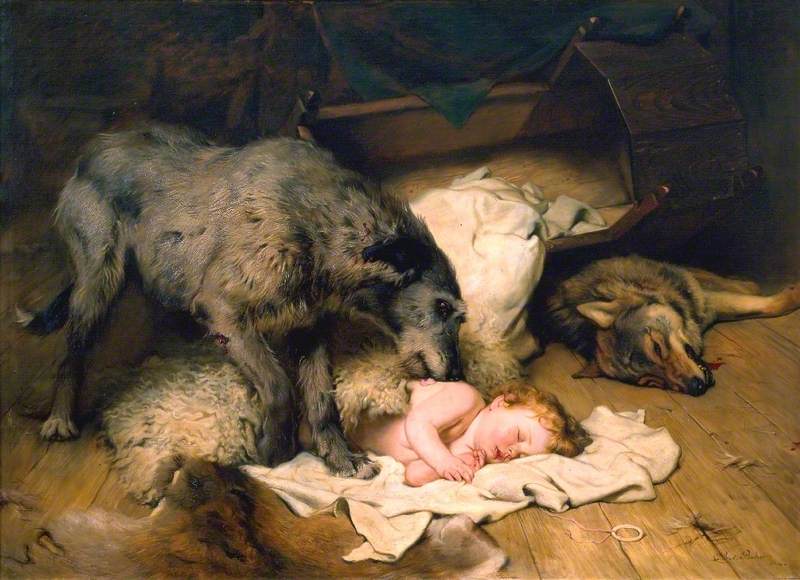
O'erturned his infants bed he found,
With blood-stained covert rent;
And all around the walls and ground
With recent blood besprent.

He called his child--no voice replied--
He searched with terror wild;
Blood, blood he found on every side,
But nowhere found his child.

'Hell hound! my child's by thee devoured,'
The frantic father cried;
And to the hilt his vengeful sword
He plunged in Gelert's side.

His suppliant looks, as prone he fell,
No pity could impart;
But still his Gelert's dying yell
Passed heavy o'er his heart.

Aroused by Gelert's dying yell,
Some slumberer wakened nigh:
What words the parent's joy could tell
To hear his infant's cry!

Concealed beneath a tumbled heap
His hurried search had missed,
All glowing from his rosy sleep,
The cherub boy he kissed.

Nor scathe had he, nor harm, nor dread,
But, the same couch beneath,
Lay a gaunt wolf, all torn and dead,
Tremendous still in death.

Ah, what was then Llewelyn's pain!
For now the truth was clear;
His gallant hound the wolf had slain,
To save Llewelyn's heir.

Vain, vain was all Llewelyn's woe:
'Best of thy kind, adieu!
The frantic blow, which laid thee low,
This heart shall ever rue.'

And now a gallant tomb they raise,
With costly sculpture decked;
And marbles storied with his praise
Poor Gelert's bones protect.

There never could the spearman pass,
Or forester, unmoved;
There, oft the tear-besprinkled grass
Llewelyn's sorrow proved.

And there he hung his horn and spear,
And there, as evening fell,
In fancy's ear he oft would hear
Poor Gelert's dying yell.

And till great Snowdon's rocks grow old,
And cease the storm to brave,
The consecrated spot shall hold
The name of 'Gelert's grave'.

Tuesday, November 16, 2010

Stopping by Woods on a Snowy Evening

by
Robert Frost


Whose woods these are I think I know.
His house is in the village, though;
He will not see me stopping here
To watch his woods fill up with snow.

My little horse must think it queer
To stop without a farmhouse near
Between the woods and frozen lake
The darkest evening of the year.

He gives his harness bells a shake
To ask if there is some mistake.
The only other sound's the sweep
Of easy wind and downy flake.

The woods are lovely, dark, and deep,
But I have promises to keep,
And miles to go before I sleep,
And miles to go before I sleep. 


Robert Frost (1874 - 1963) was an American poet mostly known for his simple-worded short poems full of imagery.
A complete collection of his poems can be found here.