Showing posts with label morality. Show all posts

Wednesday, December 8, 2010

Savage Lands & Inner Demons (Part II): Lord of the Flies

This book was one of those featured in Part 1of the IBA Literary Society's 'Literary Discussion Series' Event entitled 'Savage Lands & Inner Demons' held in IBA Main Campus on November 25, 2010.

Title: Lord of the Flies
Author: William Golding
Year of Publication: 1954
GenreMorality, Adventure
Available Online? No
There is a heart of darkness in every man; a palpitating, throbbing proclivity towards evil and malice, which only shows itself in times of desperation and survival. Evil resonates within the heart of humanity: call it Satan, Lucifer, capitalism, communism or the survival of the fittest. This habitual inclination of ours is often controlled and channeled through society and its fetters. But purity, piety and virtue seem to vanish when man is exposed to his primal instinct and true, carnal nature. 

The loss of innocence and man’s descent or fall into darkness is epic; after all, Adam and Eve, the first humans created by God succumbed to temptations! It seems the seed of evil and cruelty is embedded in the heart of new-born child before he or she even realizes the repercussion of what will come into fruition. This evil culminates into malice that was unimaginable and incomprehensible until one experiences the torment of its bearing. 

What could be more apt to fit this theme than the novel or the story that defined the true nature of man? 

His malice, greed, hunger for power and Darwinian urges towards survival can best be seen in the novel that aptly depicted the loss of humanity; the loss of innocence; the loss of childhood in a stride. 

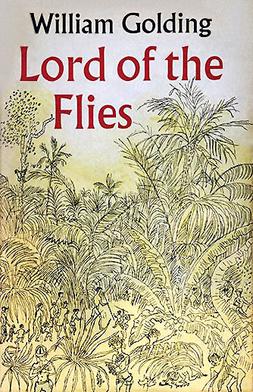
‘The Lord of the Flies’, by William Golding narrates the story of young boys marooned on an island after a plane crash in what seems to be a post apocalyptic world. (Golding, 1954)

At first, the young boys try to act in unison, understanding that one half of the group should stay and watch the signal fire, making sure its lit perpetually, so that a ship can spot the children and come to rescue.

The instinctive urge to be civilized is wrought with the frustration that comes with leadership, obeying rules and acting in an ethical manner to fit into a framework of that society desires us to be. This increases the appeal of violence and brutality as well as totalitarianism. Taken from an allegorical perspective, the novel still depicts man’s descent into savagery: how a social system collapses to lead way towards anarchy and chaos. 

For any one who is a fan of twentieth century literature, this book cannot be ignored. The terror of a child's descent into darkness and the heart wrenching tale can be interpreted on so many planes; from the moment of the crash, the words in the book speak for themselves and no praise merits this gem of literature! 

Maham Usman

Source of Image: http://upload.wikimedia.org/wikipedia/en/9/9b/LordOfTheFliesBookCover.jpg

Savage Lands & Inner Demons (Part I): Heart of Darkness

This book was one of those featured in Part 1of the IBA Literary Society's 'Literary Discussion Series' Event entitled 'Savage Lands & Inner Demons' held in IBA Main Campus on November 25, 2010.

Title: Heart of Darkness
Author: Joseph Conrad
Year of Publication: 1902
Genre: Novella, Colonialism & Morality
Available at the IBA Library? Yes
Available Online? Yes, here

“[The episode] seemed somehow to throw a kind of light on everything about me—and into my thoughts. It was somber enough too—and pitiful—not extraordinary in any way—not very clear either. No, not very clear. And yet it seemed to throw a kind of light.”         - Heart of Darkness

Are questions of morality ever clear? What is not governed by rules must be open to interpretation, must it not? Because every man’s morality is different from everyone else’s. So how does one decide what is right and what is wrong? Especially when one resides in a society where no laws shackle one to any determined code?

“[It was] not very clear” is how Joseph Conrad refers to this subject in his book Heart of Darkness (1902) and he does that by telling us a story which according to him is also “not very clear” but is meaningful for readers just the same. The story is of Charles Marlow, a captain of a steamboat who is commissioned to travel to the very ends of the Congo River, surrounded by the wilderness of dark jungles and savage societies, on a mission for the company he works for. The savagery that he witnesses is, however, not performed by the native cannibals, but by the representatives of the so-called civilized European societies sent there to ‘enlighten the natives’. These Europeans found themselves unregulated by any governing body and consequently made use of this freedom to act in all sorts of barbaric ways imaginable. Revolted by what he witnesses, Marlow puts all his hopes into a meeting with Kurtz, an ivory dealer whom it is part of his mission to fetch from his station. Kurtz is known to be a genius, an enlightened man, sent to the colony to in turn enlighten the natives and deliver them from their state of degeneration. Marlow desperately longs to meet this enlightened Kurtz, but is in for disappointment, and is forced to reassess his own values.

Heart of Darkness superbly illustrates how selfishness, greed and lust for power can overcome any nobler ideas, if left unchecked by the lack of a society or a strong code of ethics.

Azma Humayun


Source of Image: http://www.shawnswaner.com/content/binary/image001.gif