Showing posts with label article. Show all posts

Friday, March 4, 2011

From Saviours to Tyrants

This is no time to criticize a revolution. After all, they're in vogue; attempting to bring order into the lives of suppressed people. 

But what makes for a successful revolution? Is it the change that is being worked for? Is it the strength of those in revolt? Or is it the question of whether the revolt is being brought about from the top or the bottom? Or perhaps none of these factors really determine whether the revolt will be successful. Perhaps it is what happens afterwards that makes all the difference. A revolution may only be successful if it ends up transferring power from the hands of one to those of the populace. 

So what happens if this transfer of power doesn't occur? Probably what happened during the Bolshevik revolution, where the state of the people did not improve, or after the French Revolution, when an Emperor replaced the King. One tyrant may be replaced with another. That's that, end of story; no happy ending, no use of a revolution.

Don't agree with me? Then try reading George Orwell's Animal Farm (Published: 1945) for perspective. 


The book tells the story about the animals on a certain farm who are tired of the cruel treatment handed out to them by their masters - the humans, so they decide to revolt. The uprising is led by the pigs, who are the smartest creatures on the farm (representing the society's elite, ironic huh?). Other animals (making up the middle class) include horses, cows, goats, hens and a donkey; all workaholics thinking of little else all day than their duties. The sheep are the masses, mindless followers of whatever is taught to them; and the dogs are the military, strong and ruthless. 

The animals' revolt is based on very noble ideas- the equality of all animals, no killing, lots of food for all, no exploitation, etc. However, the success of the revolution gives way to power struggles, rivalry, propaganda and the breaking of the very laws, by the leaders, that they had helped pen. The middle class feels that something wrong is going on but is too busy in its work to do anything about it. The masses (sheep) barely know what's happening and continue to do what they're told. The pigs replace the humans and things go back to square one.
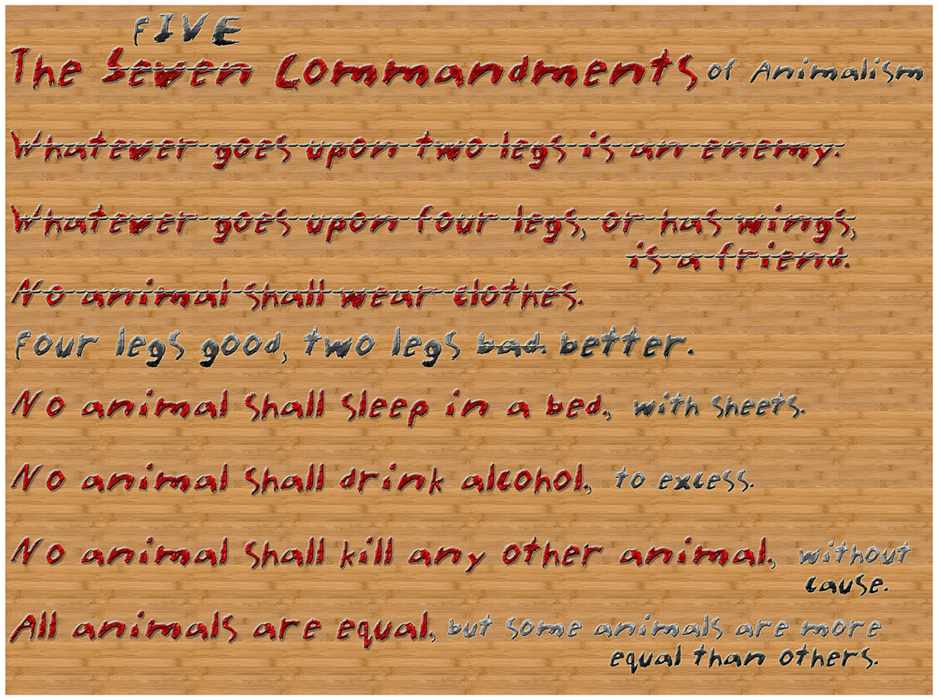

What a revolution then needs is a responsible leader; someone who wouldn't be driven by his lust for power, but by his duty to the people and society. Without this, it would only be a matter of time before the pigs turn into humans.


Source of Image: http://www.annexed.net/freedom/AnimalFarmCommandments.jpg

Tuesday, November 30, 2010

What is and What should be?

by
Syed Hasan Abid

The act of renunciation is what leads to emancipation. If we are to be recognized as free men, we must abandon some of our desires which yield temporary satisfaction. Our lives must be purged from the notion of personal gratification; for, solely, in pursuit of personal gain one ends up being slavish, failing to contribute to the beauty of human thought. For an empiricist, observation is more or less, an impregnable building; a pedestal of further discovery and insight. As an empiricist, one shall observe life intimately; but with caution. Attempts should be made to disparage confounding variables; and even the most novel insights must be ennobled but never ignored. Logic, importantly, must be revered, which is its rightful share, if we are to obviate the difficulties surrounding our world of ideals.

'The inexhaustible mystery of existence', in Russell's words, is perhaps the greatest paradox man could ever confront. Man, as servile as ever, never found in himself anything as powerful as death or fate. Their omnipotence compelled him to worship the non-human forces. But even nature, being austere and invincible, could not prevent man to progress and reason, and to conclude that these laws simply did not suffice. Man's struggle against a universe which cared nothing for his aspirations is a story of courage and greatness.

We exist in a world, which could most accurately and precisely, be referred to as the turmoil of uncertainty. It is an onerous task to foster our own ideals against forces unaware of the futility of their actions. Indifferent to the vacillation embodied in our lives, we engage ourselves in daily strife, merely to overcome the possibility of failure. Failure, as I hold implies the inability to meet certain demands; a dispute ended in vain, but may have been won, had opportunities not been squandered. These are the notions which weave the fabric of our lives. Happiness, perhaps, is what each one of us craves for. It is the most significant strand of our existence. Aristotle believed that goodness in life is unavailing, if there is no room for happiness. It is with such an approach we should fashion ourselves and embrace the world with all its disparate laws.

But what is the inevitable conclusion of life? Betrayal. We must acknowledge that we, as a conscious entity, will at last cease to exist. All the knowledge gained, the decks stacked against others, all grudges and every faint memory shall fade away with death. Then why struggle, do the daily chores or face humiliation at the hands of those self-righteous donkeys? To be honest, we do not have many options. This mechanism is responsible for the passivity and submission of man before the omnipotence of nature. One of the most senile tricks is being used here; coerce the opponent into surrender by making sure that he runs out of options. Nature and the One who decides all the edicts, its ruler, is Whom we are ought to serve. It may be equivocal to regard that we deserve more; for, each one of us is liable to God, each one of us is a debtor.

In search of knowledge, wisdom and love we shall live and hope that some day a thousand splendid suns will resolve all the enigmas; that once men will realize that preference for dance over meditation, intellect over impulses is the cause of all sorrows. Finally, I would like to give the reader a personal insight into the meaning of life by furnishing the following lines:

'Meticulously, if one gazes into the eye of an impecunious, one would discover an array of ambience. There would be indescribable pain, fear and anxiety. One would find courage and hope too, obscured in a corner. Then perhaps we shall find all our answers, which are more important than all political debates and religious dogmas of the world.'