Showing posts with label George Orwell. Show all posts

Friday, March 4, 2011

From Saviours to Tyrants

This is no time to criticize a revolution. After all, they're in vogue; attempting to bring order into the lives of suppressed people. 

But what makes for a successful revolution? Is it the change that is being worked for? Is it the strength of those in revolt? Or is it the question of whether the revolt is being brought about from the top or the bottom? Or perhaps none of these factors really determine whether the revolt will be successful. Perhaps it is what happens afterwards that makes all the difference. A revolution may only be successful if it ends up transferring power from the hands of one to those of the populace. 

So what happens if this transfer of power doesn't occur? Probably what happened during the Bolshevik revolution, where the state of the people did not improve, or after the French Revolution, when an Emperor replaced the King. One tyrant may be replaced with another. That's that, end of story; no happy ending, no use of a revolution.

Don't agree with me? Then try reading George Orwell's Animal Farm (Published: 1945) for perspective. 


The book tells the story about the animals on a certain farm who are tired of the cruel treatment handed out to them by their masters - the humans, so they decide to revolt. The uprising is led by the pigs, who are the smartest creatures on the farm (representing the society's elite, ironic huh?). Other animals (making up the middle class) include horses, cows, goats, hens and a donkey; all workaholics thinking of little else all day than their duties. The sheep are the masses, mindless followers of whatever is taught to them; and the dogs are the military, strong and ruthless. 

The animals' revolt is based on very noble ideas- the equality of all animals, no killing, lots of food for all, no exploitation, etc. However, the success of the revolution gives way to power struggles, rivalry, propaganda and the breaking of the very laws, by the leaders, that they had helped pen. The middle class feels that something wrong is going on but is too busy in its work to do anything about it. The masses (sheep) barely know what's happening and continue to do what they're told. The pigs replace the humans and things go back to square one.
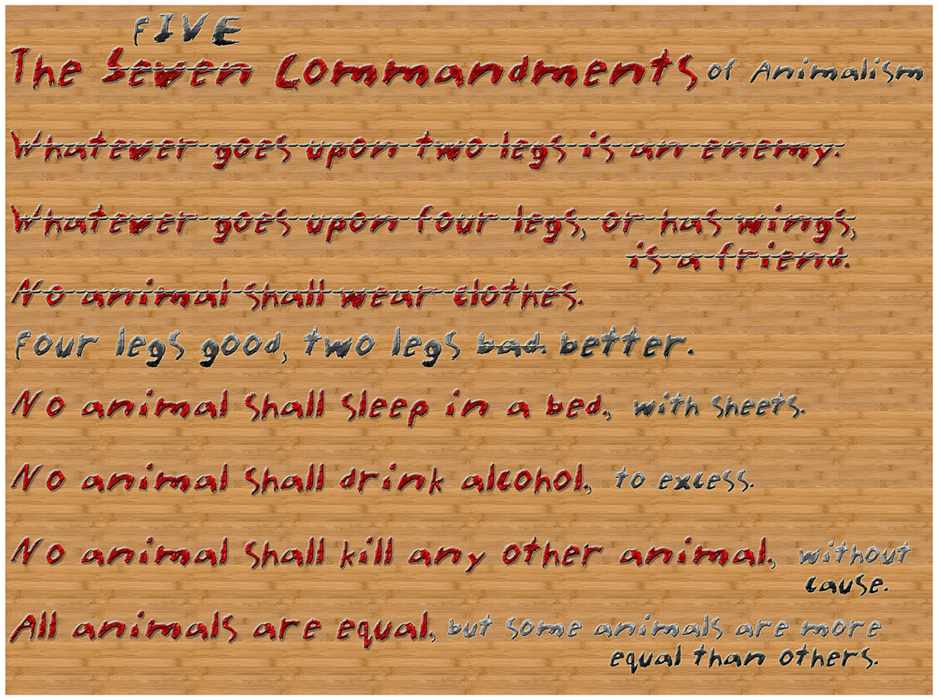

What a revolution then needs is a responsible leader; someone who wouldn't be driven by his lust for power, but by his duty to the people and society. Without this, it would only be a matter of time before the pigs turn into humans.


Source of Image: http://www.annexed.net/freedom/AnimalFarmCommandments.jpg

Wednesday, November 24, 2010

1984: A Commentary on the Present?

Title: 1984
Author: George Orwell
Year of Publication: 1949
Genre: Political fiction, Science fiction
Looking at an era of the past is always illuminating. One can learn from the mistakes one made or rejoice in one’s achievements. On the other side of the mirror it can also reflect a disturbing picture, especially if the reflection displays an apt representation of the present itself.
Let me make one thing clear at the outset. I do not intend to write a review of the famous book by Mr. Orwell. What I would simply like to do is discuss some of the themes in this book and how they do or do not bear a striking similarity to the present time.
It seems to me that Mr. Orwell was quite unaware of the fact that his book was years ahead of its time, and rather prophetic in nature. The 80s may not have turned out to be the way he imagined them to be in the 40s, but the 2000s definitely bear a remarkable resemblance to his imagination.
The lead character in 1984 is a skilful portrayal of today’s youth. The distrust and deceit experienced by Wilson throughout the book is common amongst us. Just like the concept of ‘Thought Police’ monitoring each and every aspect of life, today the same thing is happening. The use of Artificial Intelligence has enabled man to maintain tons of gigabytes of surveillance information on each and every individual who has at any point used an electronic device. 
In the book there are several instances when the protagonist realizes that however hard he tries to defy the authorities, someone, somewhere will eventually be able to apprehend him. A very similar thing is happening today. The Defense Departments of the world can frame anyone for anything. May it be terrorist attacks, helping fundamentalist organizations flourish, or even something as inconsequential as wearing a scarf. No one is safe. Just because you were friends with someone on “Facebook”, who was friends with someone else, who had an uncle living in Saudi Arabia, whose wife went to study the Quran, and whose teacher shared the same name with Osama, you would suddenly appear on their radar as a suspicious character.
The helplessness experienced by Wilson after being captured can be compared to the misery of several innocent Pakistani, Indian, Arabic men and women who were imprisoned for crimes so heinous that they are even difficult to imagine being performed. They were kept in extremely harrowing circumstances and treated as inhumanly as possible. Just like the prisoners of ‘Thought Police’ their voices were also hushed. No one came to their rescue.
If anyone is reading this, I would recommend you to go ahead and read the book. You may find it tragic, depressing, and troubling but one thing you will not be able to say is “There is no truth to it.”

Adil Majid
 
Source of Image: http://knowledgefiles.com/kfwp/wp-content/gallery/covers/1984.jpg