Showing posts with label Shakespeare. Show all posts

Friday, June 24, 2011

To live or to Die - Hamlet's Debate


One of the most quoted lines from literature is 'To be or not to be' from Shakespeare's Hamlet
Yet few of us actually realize what Shakespeare was talking about when we quote this line. In this soliloquy from Scene 1, Act II of the play, Hamlet is debating the question of whether to live and bear with patience all the injustices of this world, or to die and go to another world whose conditions you know nothing about, whether they'd be better or a thousand times worse.

To be, or not to be: that is the question:
Whether 'tis nobler in the mind to suffer
The slings and arrows of outrageous fortune,
Or to take arms against a sea of troubles,
And by opposing end them? To die: to sleep;
No more; and by a sleep to say we end
The heart-ache and the thousand natural shocks
That flesh is heir to, 'tis a consummation
Devoutly to be wish'd. To die, to sleep;
To sleep: perchance to dream: ay, there's the rub;
For in that sleep of death what dreams may come
When we have shuffled off this mortal coil,
Must give us pause: there's the respect
That makes calamity of so long life;
For who would bear the whips and scorns of time,
The oppressor's wrong, the proud man's contumely,
The pangs of despised love, the law's delay,
The insolence of office and the spurns
That patient merit of the unworthy takes,
When he himself might his quietus make
With a bare bodkin? who would fardels bear,
To grunt and sweat under a weary life,
But that the dread of something after death,
The undiscover'd country from whose bourn
No traveller returns, puzzles the will
And makes us rather bear those ills we have
Than fly to others that we know not of?
Thus conscience does make cowards of us all;
And thus the native hue of resolution
Is sicklied o'er with the pale cast of thought,
And enterprises of great pith and moment
With this regard their currents turn awry,
And lose the name of action.

I came across a wonderful line-by-line explanation of this soliloquy from Stevepavlina.com:

To live or not to live, that is the question.
Is it better to stay, and suffer all of the ridiculous highs and lows of life?
Or to leave, and avoid the trials and tribulations altogether?
We cannot answer this.
Even after you die you still might dream. And who knows what you'll dream?

Click here to read the complete explanation!

Tuesday, May 17, 2011

Emotions vs. Rationale

The sign of a good persuasive speaker is that s/he can influence the audience- inspire them, and move them to do what s/he wills. Courses in public speaking teach us techniques in body movements, voice control, etc.; but the fact remains that unless we focus on the sentiments of the listeners and appeal to them, we wouldn't be half as successful.

Two great examples of effective persuasive speaking come from the Bard Shakespeare's Julius Caesar. The play revolves around the murder of the Roman general Julius Caesar by his most faithful companions, including Brutus, his loyal friend, from the motive that Caesar's death would be good for  Rome. Brutus then faces the Roman public and justifies his cold-blooded action magnificently. Rome is now on Brutus's side. Brutus is now content, and even a little complacent. He leaves the crowd to be addressed by Marc Antony, Caesar's friend, who will definitely try to win the angry crowd over to sympathizing with Caesar. Brutus is confident that Antony will fail, but he under-estimates Antony's shrewdness. Brutus gave the crowd rational reasons for his deed and justifies it with fact. Antony, on the other hand, stirs the public's emotions, and wins.

If you don't know what I'm talking about, here is the scene from the play:

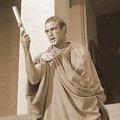
Julius Caesar (1953 movie starring Marlon Brando as Antony and James Mason as Brutus)


ACT III,

SCENE II. The Forum.

Enter BRUTUS and CASSIUS, and a throng of Citizens
We will be satisfied; let us be satisfied.
Then follow me, and give me audience, friends.
Cassius, go you into the other street,
And part the numbers.
Those that will hear me speak, let 'em stay here;
Those that will follow Cassius, go with him;
And public reasons shall be rendered
Of Caesar's death.
I will hear Brutus speak.
I will hear Cassius; and compare their reasons,
When severally we hear them rendered.
Exit CASSIUS, with some of the Citizens. BRUTUS goes into the pulpit
The noble Brutus is ascended: silence!
Be patient till the last.
Romans, countrymen, and lovers! hear me for my
cause, and be silent, that you may hear: believe me
for mine honour, and have respect to mine honour, that
you may believe: censure me in your wisdom, and
awake your senses, that you may the better judge.
If there be any in this assembly, any dear friend of
Caesar's, to him I say, that Brutus' love to Caesar
was no less than his. If then that friend demand
why Brutus rose against Caesar, this is my answer:
--Not that I loved Caesar less, but that I loved
Rome more. Had you rather Caesar were living and
die all slaves, than that Caesar were dead, to live
all free men? As Caesar loved me, I weep for him;
as he was fortunate, I rejoice at it; as he was
valiant, I honour him: but, as he was ambitious, I
slew him. There is tears for his love; joy for his
fortune; honour for his valour; and death for his
ambition. Who is here so base that would be a
bondman? If any, speak; for him have I offended.
Who is here so rude that would not be a Roman? If
any, speak; for him have I offended. Who is here so
vile that will not love his country? If any, speak;
for him have I offended. I pause for a reply.
None, Brutus, none.
Then none have I offended. I have done no more to
Caesar than you shall do to Brutus. The question of
his death is enrolled in the Capitol; his glory not
extenuated, wherein he was worthy, nor his offences
enforced, for which he suffered death.
Enter ANTONY and others, with CAESAR's body
Here comes his body, mourned by Mark Antony: who,
though he had no hand in his death, shall receive
the benefit of his dying, a place in the
commonwealth; as which of you shall not? With this
I depart,--that, as I slew my best lover for the
good of Rome, I have the same dagger for myself,
when it shall please my country to need my death.
Live, Brutus! live, live!
Bring him with triumph home unto his house.
Give him a statue with his ancestors.
Let him be Caesar.
Caesar's better parts
Shall be crown'd in Brutus.
We'll bring him to his house
With shouts and clamours.
My countrymen,--
Peace, silence! Brutus speaks.
Peace, ho!
Good countrymen, let me depart alone,
And, for my sake, stay here with Antony:
Do grace to Caesar's corpse, and grace his speech
Tending to Caesar's glories; which Mark Antony,
By our permission, is allow'd to make.
I do entreat you, not a man depart,
Save I alone, till Antony have spoke.
Exit
Stay, ho! and let us hear Mark Antony.
Let him go up into the public chair;
We'll hear him. Noble Antony, go up.
For Brutus' sake, I am beholding to you.
Goes into the pulpit
What does he say of Brutus?
He says, for Brutus' sake,
He finds himself beholding to us all.
'Twere best he speak no harm of Brutus here.
This Caesar was a tyrant.
Nay, that's certain:
We are blest that Rome is rid of him.
Peace! let us hear what Antony can say.

Thursday, April 21, 2011

Sonnet 116

by
William Shakespeare

Let me not to the marriage of true minds
Admit impediments. Love is not love
Which alters when it alteration finds,
Or bends with the remover to remove:
O no! it is an ever-fixed mark
That looks on tempests and is never shaken;
It is the star to every wandering bark,
Whose Worth's unknown, although his height be taken.
Love's not Time's fool, though rosy lips and cheeks
Within his bending sickle's compass come;
Love alters not with his brief hours and weeks,
But bears it out even to the edge of doom:
If this be error and upon me proved,
I never writ, nor no man ever loved.
  

Source of Image: http://images2.layoutsparks.com/1/151793/deadly-red-rose-image-31000.jpg

Wednesday, December 1, 2010

Sonnets 29, 72 & 145

by
William Shakespeare

Though known mostly for his plays, Shakespeare was also a very accomplished poet. His 154 sonnets covering themes such as love, mortality, depression and hope, are definitely a collector's item, especially for those bitten by the love bug. Tip for all the guys out there - most girls melt when they hear a Shakespeare sonnet!

As I couldn't choose one, here are three of my favourite sonnets. 


 29
  
When in disgrace with Fortune and men's eyes,
I all alone beweep my outcast state,
And trouble deaf heaven with my bootless cries,
And look upon my self and curse my fate,
Wishing me like to one more rich in hope,
Featured like him, like him with friends possessed,
Desiring this man's art, and that man's scope,
With what I most enjoy contented least,
Yet in these thoughts my self almost despising,
Haply I think on thee, and then my state,
Like to the lark at break of day arising
From sullen earth sings hymns at heaven's gate,
For thy sweet love remembered such wealth brings,
That then I scorn to change my state with kings.


72
O lest the world should task you to recite,
What merit lived in me that you should love
After my death (dear love) forget me quite,
For you in me can nothing worthy prove.
Unless you would devise some virtuous lie,
To do more for me than mine own desert,
And hang more praise upon deceased I,
Than niggard truth would willingly impart:
O lest your true love may seem false in this,
That you for love speak well of me untrue,
My name be buried where my body is,
And live no more to shame nor me, nor you.
For I am shamed by that which I bring forth,
And so should you, to love things nothing worth.


145

Those lips that Love's own hand did make,
Breathed forth the sound that said 'I hate',
To me that languished for her sake:
But when she saw my woeful state,
Straight in her heart did mercy come,
Chiding that tongue that ever sweet,
Was used in giving gentle doom:
And taught it thus anew to greet:
'I hate' she altered with an end,
That followed it as gentle day,
Doth follow night who like a fiend
From heaven to hell is flown away.
'I hate', from hate away she threw,
And saved my life saying 'not you'.


A complete collection of Sonnets 1-154 can be found here.